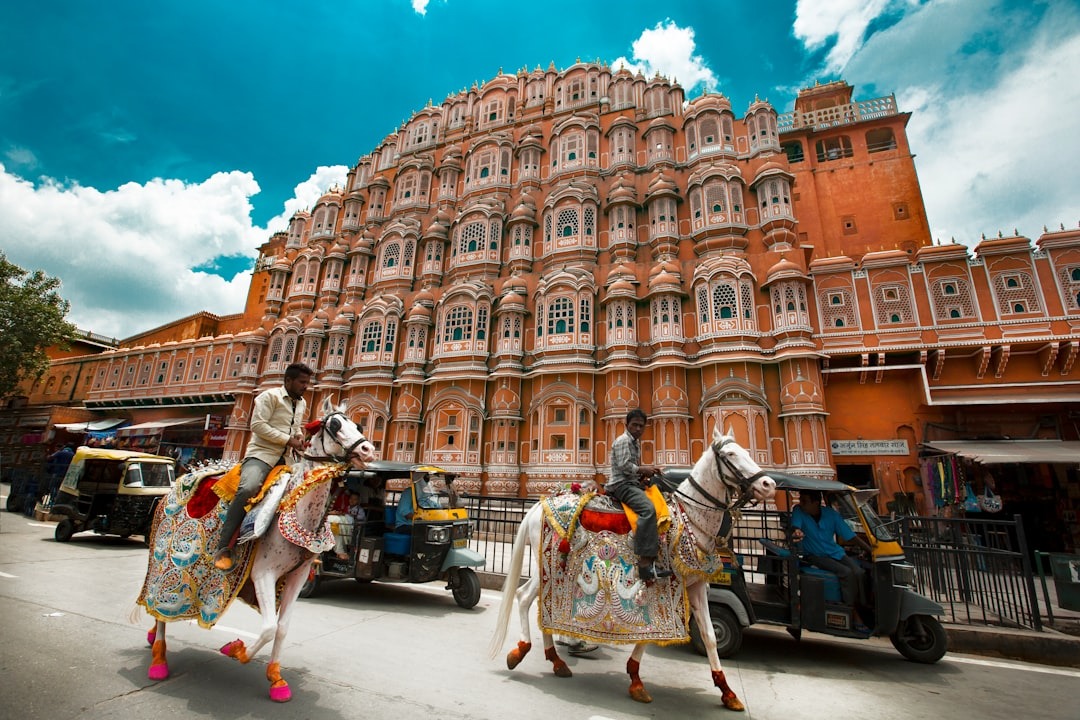
Jaipur is India’s first planned city, a grid of pink-washed bazaars, palaces, and gates wrapped inside an 18th-century wall, with newer districts spreading south and east. Where you sleep decides whether you wake up inside that history or a short auto ride from it. This guide covers where to stay in Jaipur by neighborhood and by budget, from heritage havelis in the walled city to quiet garden hotels in Bani Park and Civil Lines.
Maharaja Sawai Jai Singh II founded the city in 1727, moving his capital down from the hill fort at Amer, eleven kilometers north, because Amer had run short of room and water. What he built instead was unusual for its time: a city laid out on a grid, divided into nine rectangular blocks, ringed by a wall with gates. In 1876 the whole walled city was painted pink to welcome the Prince of Wales, and the color stuck. In 2019 UNESCO listed the walled city as a World Heritage Site. You feel all of this at street level, where the bazaars still sort themselves by trade: jewelry in Johari Bazaar, textiles and trinkets in Bapu Bazaar, brass and sweets in Tripolia.
I spent the Covid lockdown in Rajasthan, and Jaipur is the city I kept circling back to. It is the easiest entry point in the state, the corner of the Golden Triangle that gives most visitors their first real taste of India, and it is forgiving in a way that Delhi is not.
The food alone earns it a trip. Rajasthani cooking is built for a desert, heavy on ghee, lentils, and slow-cooked meat. Dal baati churma is the plate that explains the region: baked wheat balls cracked open and drowned in ghee, a spiced lentil dal, and a sweet crumble on the side. Laal maas is the one for meat eaters, a fierce mutton curry that gets its red from Mathania chillies. For breakfast, the move is a pyaaz kachori, a deep-fried pastry packed with spiced onion, and a glass of thick lassi from one of the old shops on MI Road. Save room for ghewar, a disc of honeycombed syrup that shows up around the festivals.
Timing matters more here than people expect. The window worth planning around is October to March, when days sit in the 20s and the evenings actually cool off. December and January nights can drop near 5°C, so pack a layer. April through June is punishing, regularly above 40°C, the kind of heat that rearranges your whole day around shade and air-conditioning. January is also when the city fills for the Jaipur Literature Festival and the kite festival on Makar Sankranti, so book early if those are the draw.
Getting in is simple. Jaipur International Airport sits at Sanganer, about 13 kilometers south of the center, with an Ola or Uber into town running 250 to 400 rupees. Jaipur Junction is the main railway station, well connected to Delhi and Agra, and it sits on the metro’s Pink Line. Once you are here, the honest truth is that the metro covers very little of what you came to see. You will live on autos and app cabs, and the city is spread out enough that your hotel’s location does real work. Base yourself near your priorities, because crossing Jaipur in afternoon traffic is its own small expedition.
The soft-landing logic for Jaipur is about matching the base to your tolerance for chaos. The walled city puts the headline sights at your feet and the noise in your room. The modern central districts give you reliable hotels, restaurants, and easier roads, at the cost of atmosphere. The quieter colonies trade the bazaar energy for sleep. None of these is wrong. They are different trips.
| Area | Style | Energy | Close to sights | Crowding | Best for |
|---|---|---|---|---|---|
| Pink City (Walled City) | Historic, bazaar-heavy, landmark-first | High | Very high | High | First-timers who want sights on foot, photographers, market hunters |
| C-Scheme / Ashok Nagar | Modern central city | Medium | Medium | Medium | Comfort, restaurants, easier car access |
| Bani Park | Residential heritage guesthouses | Low-medium | Medium | Low-medium | Sleep quality, railway access, families |
| MI Road / Panch Batti | Central commercial, transit-friendly | Medium-high | Medium | Medium-high | Short stays, station access, shoppers |
| Civil Lines / Rambagh | Leafy, upscale, calmer | Low-medium | Medium | Low | Luxury, sleep quality, a refined base |
| Amer / Amber Fort | Fort-side, hillside, resort-style | Low-medium | Medium | Low-medium | Fort lovers, quieter stays, second visits |
Top picks if you’re short on time
- Samode Haveli for a true heritage splurge inside the old city.
- Rambagh Palace for the full Jaipur bucket-list fantasy, if money is no object.
- Holiday Inn Jaipur City Centre for easy, reliable comfort in central C-Scheme.
- Tara Niwas in Bani Park for a quiet, soft-landing budget room near the station.
- 66 Residency in Civil Lines for the best cheap proper-hotel room in town.
The Pink City: best for sleeping inside the history

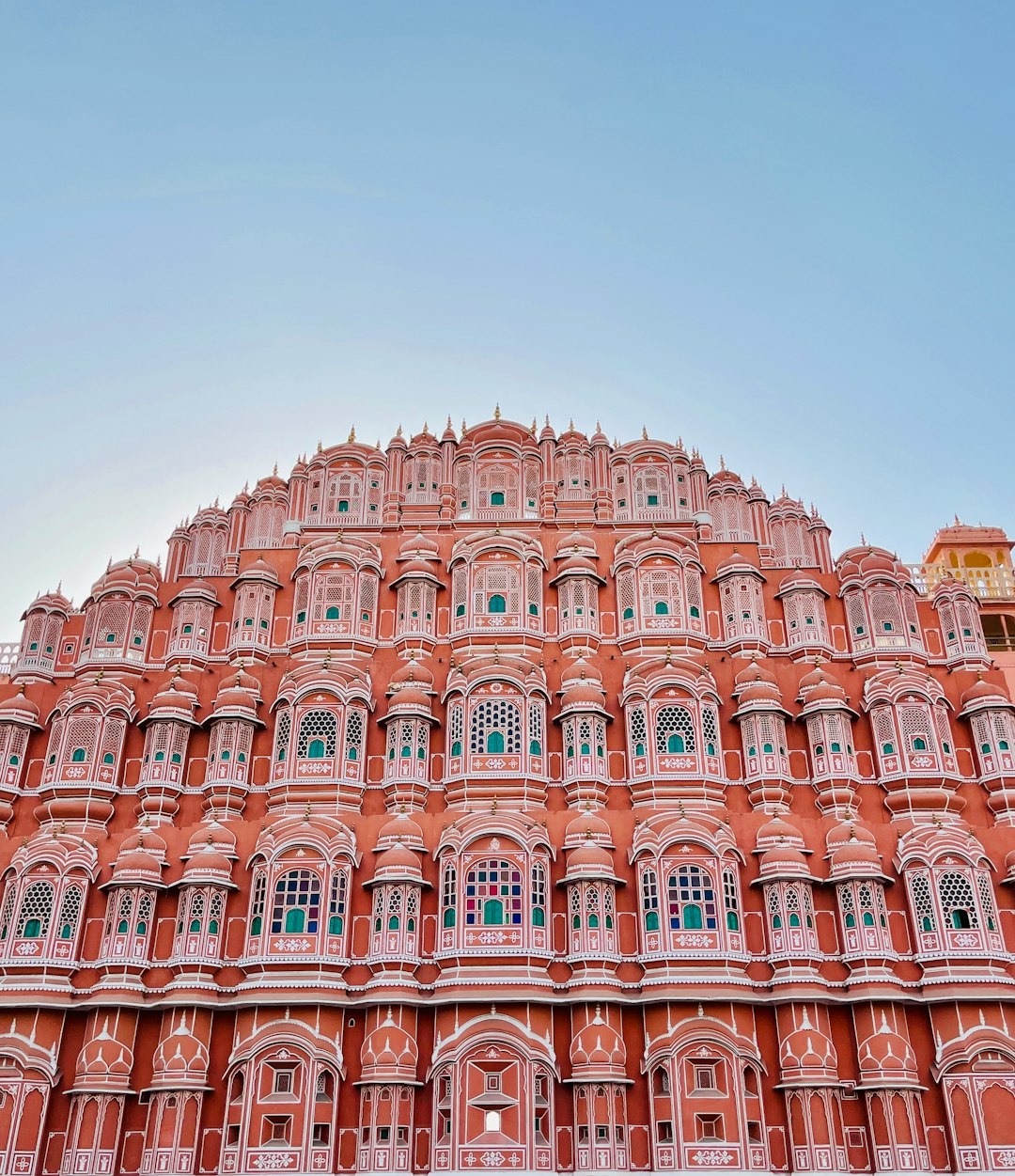
This is the Jaipur you came for. The walled city is the historic core, a dense grid of pink facades where Hawa Mahal, City Palace, Jantar Mantar, and the old bazaars sit within a few minutes of each other. If your priority is walking out the door into the postcard, you stay here, full stop.
It is also the loudest, most congested part of the city. The lanes were laid out for foot traffic and handcarts, not SUVs, so cars crawl and horns are the background track from morning on. The bazaars wrap the landmarks: Johari Bazaar for jewelry, Bapu Bazaar for textiles and juttis, Tripolia for brass and lac bangles. You can lose an afternoon in them without trying.
For a first trip, this is the most rewarding base in Jaipur, as long as you go in clear-eyed about the noise. Pick a hotel set back from the busiest market lanes, or one with real sound insulation, and the trade works in your favor. Sleep deep in the grid above a bazaar and you will hear the city all night.
Pros: the headline sights on foot; the bazaars at your door; the only base where you actually sleep inside the old city. Cons: traffic and horns; tight lanes that make car drop-offs slow; lighter sleep near the markets; facilities vary a lot, since most options are heritage buildings rather than full-service hotels.

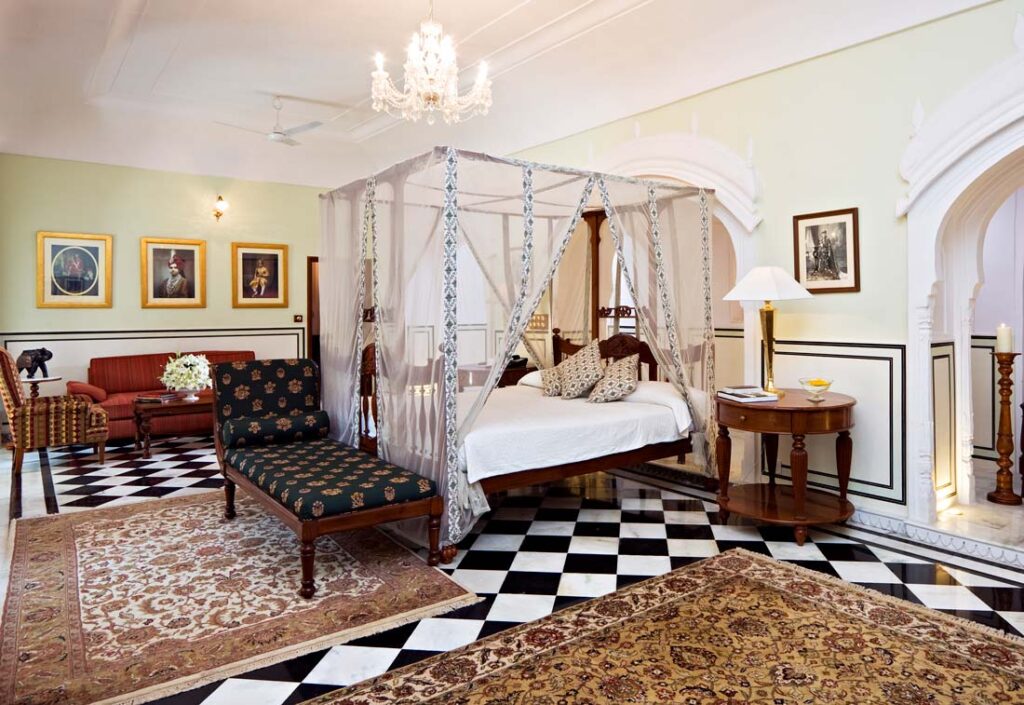
Samode Haveli
Built around 1799 as the townhouse of the Rawals of Samode, the noble family who served as prime ministers to the Jaipur court, Samode Haveli is the real thing rather than a themed approximation. The grandest rooms came later, when Rawal Sheo Singh added the hand-painted Durbar Hall and the mirrored Sheesh Mahal in the mid-19th century, and the frescoes that cover them are said to be around 250 years old. It has been a heritage hotel since 1988, still run by the family that inherited it, and it wears its age like good tailoring: arched verandas, inlaid doors, carved woodwork, and courtyards that have been receiving guests for longer than most countries have had hotels. The facility stack is rare for a property this deep in the old city, with a full-service spa, a steam room, a fitness centre, and an outdoor pool set in a garden courtyard, so the history arrives with the things that make a hot-weather trip bearable.
It sits in Gangapole, tucked into the quieter northeast edge of the walled city. Hawa Mahal and the City Palace are each about a 15-minute walk or a 5-minute auto, so the headline sights stay genuinely close without putting you on the loudest market street, and the old city’s textile and craft bazaars begin within that same radius. For anything beyond the walls, including Amber Fort at roughly a 15-minute drive, you will want an auto or a cab.
Skip it if you want a sleek modern room or a big resort pool deck. This is a 175-year-old manor, and the charm and the quirks arrive together.
Check prices and availability → · free cancellation on most rooms

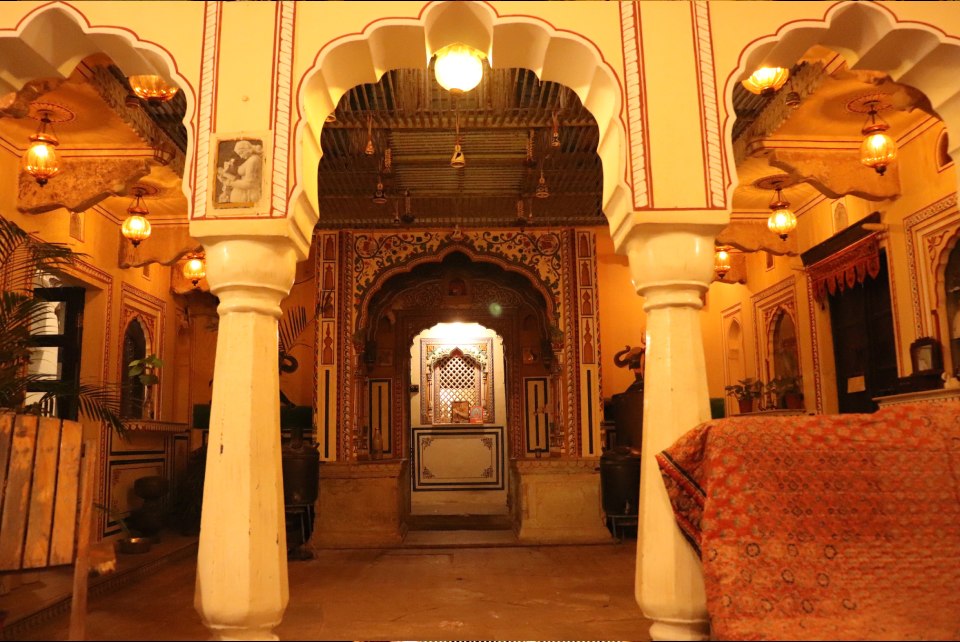
Jaipur Haveli
A heritage haveli at a fraction of the splurge, set inside a roughly 300-year-old building in the old jewelers’ quarter by Johari Bazaar. This is a small, simple operation rather than a grand palace hotel: an on-site restaurant, a rooftop terrace for breakfast and sunset, and air-conditioned rooms that keep their old bones. There is no pool and no lift, and that is precisely the trade, a genuinely centuries-old haveli at a midrange rate instead of a full-service hotel with a marble lobby.
Hawa Mahal is an 8-minute walk and the City Palace about 12 minutes on foot, just beyond it, so the core landmark cluster is genuinely walkable from your door, and the jewelry stalls of Johari Bazaar are in the same radius the building has stood in for three centuries. You are inside the old-city lanes here, which means street noise is part of the deal and autos are the move for anything outside the walls. Not for you if you need a pool, a gym, or a lift to your floor.
Check prices and availability → · free cancellation on most rooms

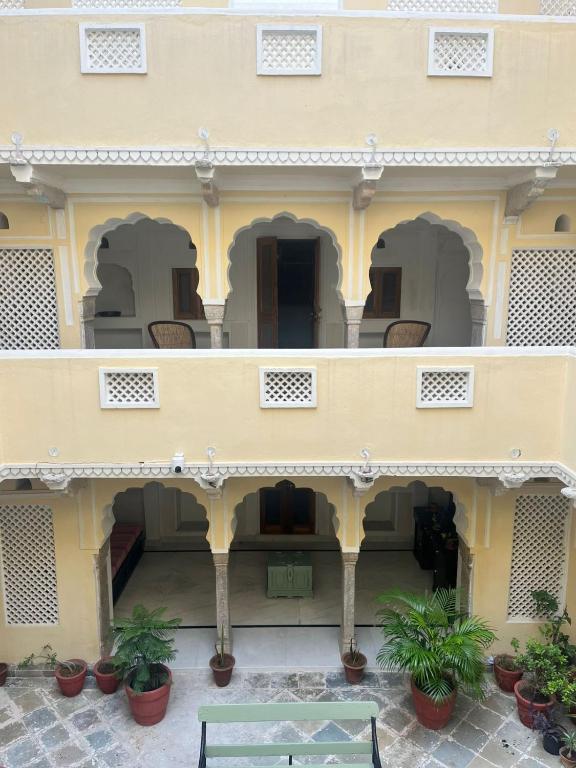
Khush Haveli
A small, well-run guesthouse that punches far above its price, with one of the highest guest scores in the whole walled city. The rooms are simple but cover the things that actually matter in Jaipur: working air-conditioning, a private bathroom, and hot water. This is a clean, no-drama place to sleep cheaply inside the Pink City, not a hotel with a front-desk-and-bellhop operation.
It sits in the central walled city, with City Palace about a 19-minute walk away. Jantar Mantar and Hawa Mahal fall in the same cluster just beyond the palace, the three of them within about 400 meters of each other, so one walk covers the headline sights. The surrounding bazaar lanes mean food and shopping are at street level, and autos are easy to flag for anything further out. Skip it if you want hotel-grade service or a quiet, sealed-off room; this is a simple guesthouse in a busy quarter, and you trade polish for price and location.
Check current rates for Khush Haveli · 9.5 on Booking
C-Scheme and Ashok Nagar: best for easy comfort and a modern central base

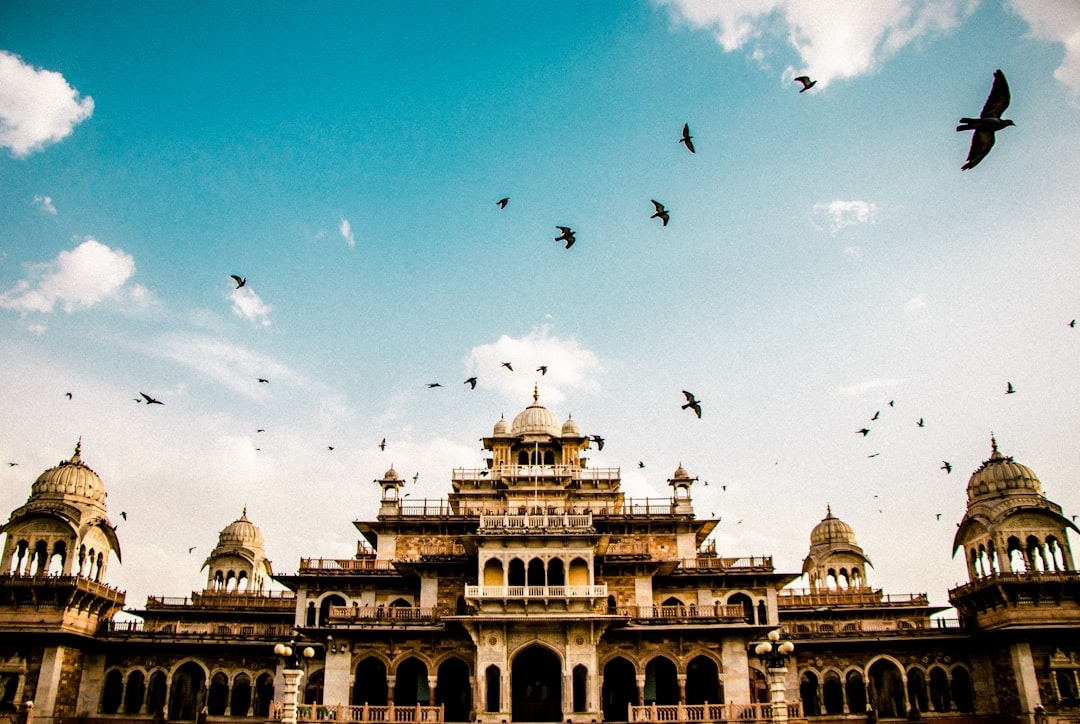
C-Scheme is Jaipur’s modern, planned center, and for a lot of first-time visitors it is the smartest base in the city. Laid out as an orderly colony of wide roads and roundabouts around Central Park and Bhawani Singh Road, it holds most of Jaipur’s reliable mid-to-upper hotels, along with the cafes, restaurants, and shops that the walled city does not really do. This is the part of Jaipur that behaves like a contemporary Indian city rather than a medieval one.
The texture here is calmer and far more legible than inside the walls. Sidewalks exist, app cabs arrive without a fight, and you can find a flat white as easily as a thali. Central Park is the green heart of the district, a genuine city park with a jogging track and one of the tallest flagpoles in the country, and the surrounding streets stay safe and active into the evening. The obvious cost is atmosphere. The pink walls and the bazaar theater are no longer outside your door, so you will take a short auto into the old city most days, usually 10 to 15 minutes depending on traffic.
I would steer two kinds of traveler here without hesitation: anyone a little nervous about the intensity of India on a first trip, and anyone who simply values a dependable room and an easy arrival over romance. You give up the bazaar-at-your-door drama. You get reliable sleep, real dinner options, and a base that never turns a late flight into an ordeal.
Pros: reliable hotels and restaurants, easier roads, genuinely central, walkable to MI Road. Cons: less atmospheric than the old city, sightseeing needs autos, and the best hotels can feel businesslike rather than characterful.

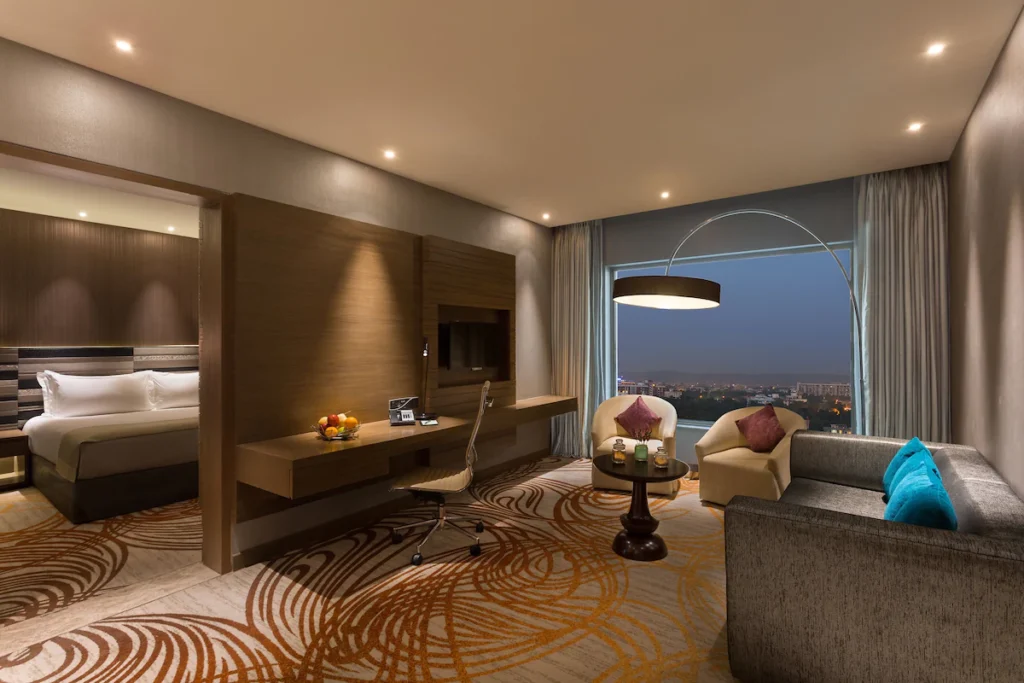
Holiday Inn Jaipur City Centre
A full-service international five-star that makes Jaipur feel managed. You get an outdoor pool, a spa, a gym, and four on-site restaurants, the kind of complete setup where a long, hot travel day can end without leaving the building. The rooms are modern and chain-consistent, and in a city that can be anything but predictable, that predictability is genuinely the selling point.
At 22 Godam Circle in C-Scheme, you are on the modern, cab-friendly side of the center. MI Road’s shops and restaurants are a 3-minute drive, the City Palace about 12 minutes by car, and the airport roughly 20 minutes out, all on wide roads that keep late check-ins and early departures painless. Skip it if you came for heritage character. This is a polished business hotel, and it feels like one.
Check prices and availability → · 8.1 on Booking + free cancellation on most rooms

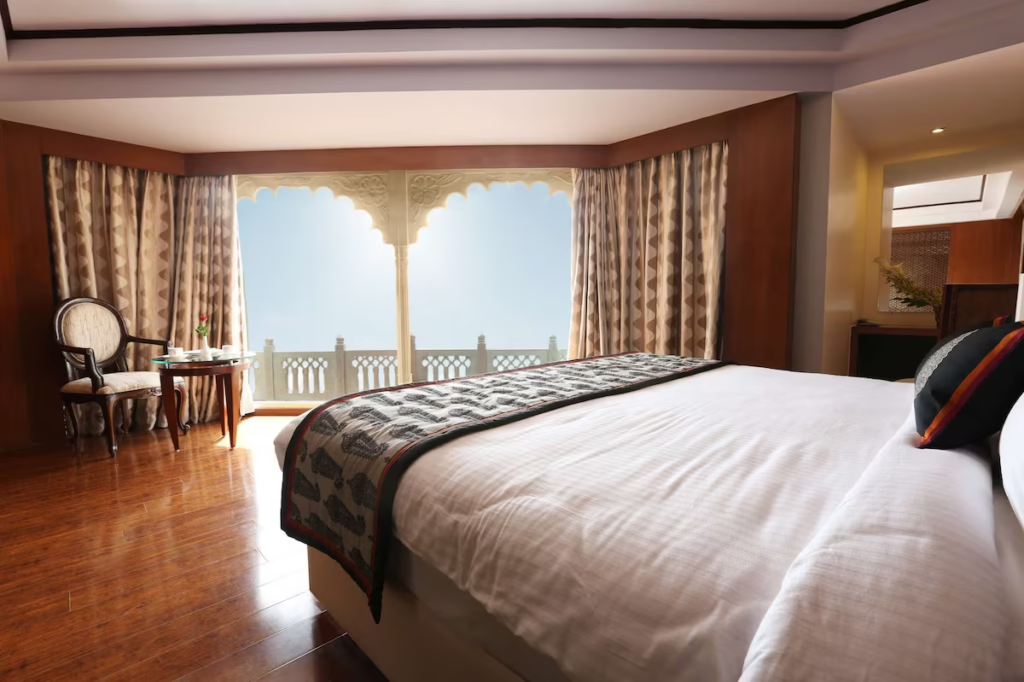
Golden Tulip Jaipur City Center
A business-class city hotel with a fuller facility stack than its rate suggests: a pool, a spa, a gym, an on-site restaurant, and a hundred modern air-conditioned rooms with the practical touches, kettle, minibar, work desk, that earn their keep on a multi-city Rajasthan trip. It is not characterful. It is competent, and on a tight Golden Triangle schedule, competent is worth a great deal.
Near Panch Batti on the seam between C-Scheme and MI Road, it sits about a 5-minute drive from both the railway station and the main bus stand, which makes onward travel to Agra or Udaipur simple. Panch Batti’s restaurants and the MI Road shopping strip are a short walk or a quick auto, and the old-city sights are a 10-to-15-minute ride. Not the pick if you want to walk out into the bazaars. This is a transit-smart base, not a sightseeing-on-foot one.
Check prices and availability → · 8.4 on Booking + free cancellation on most rooms
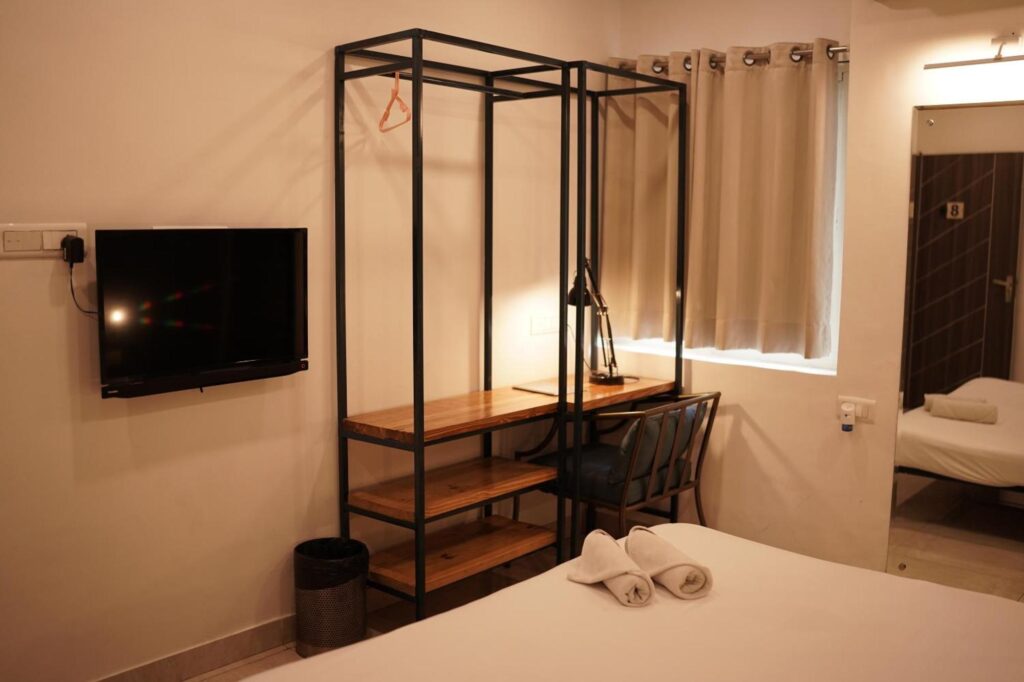
Blue Beds Hostel
A well-run hostel with private rooms, for travelers who want hostel prices without the dorm compromises. You get air-conditioned rooms with private bathrooms and hot water, a shared kitchen, a terrace, and an on-site restaurant, and the social side is real without tipping into party-hostel chaos, which makes it a rare budget pick that suits solo travelers and light sleepers at once.
On Bhawani Singh Road in C-Scheme, it sits beside Central Park, with the Ram Mandir bus stop about a 6-minute walk away and the old-city sights roughly a 15-minute auto. You are in a modern, walkable colony here, cafes and everyday shops within reach. Skip it if you need a sealed-off hotel room or full service. It is a hostel, with a hostel’s sociable hum.
Check prices and availability → · 8.8 on Booking + free cancellation on most rooms
Bani Park: best for a quiet night and easy station access

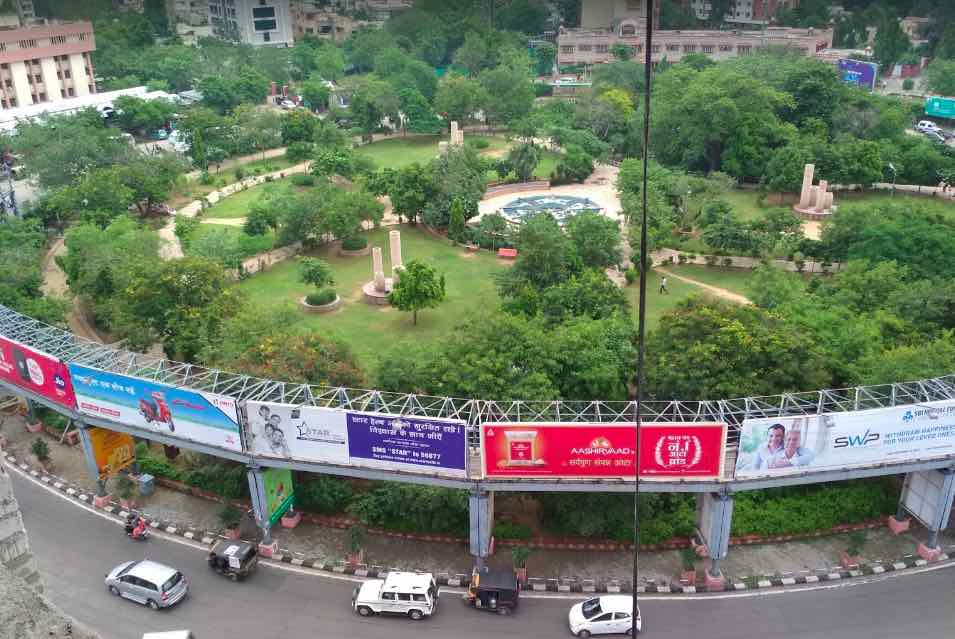
Bani Park is the leafy residential district just west of the railway line, and for decades it has been Jaipur’s quiet-sleep quarter, full of family-run, heritage-style guesthouses on calm streets. If your priority is a restful base rather than a front-row seat, this is where you come.
Day to day, the quiet is both the feature and the limitation. There is little to do on foot beyond your own hotel, so this is not a wander-out-the-door neighborhood. What it offers instead is real rest and unusually easy logistics. The railway station and the Sindhi Camp bus stand are minutes away, which makes Bani Park a smart hinge for the wider Rajasthan trip, the place to sleep before an early train to Jodhpur or a morning car to Agra. The old city is a short auto ride rather than a walk, generally around 15 minutes depending on traffic.
For families, older travelers, and anyone who values a good night’s sleep over stepping straight into the action, this is the most comfortable corner of central Jaipur.
Pros: quiet streets and genuine sleep, heritage-guesthouse character, very close to the station for onward travel. Cons: little on foot, autos needed for every sight, and fewer restaurants within walking range.

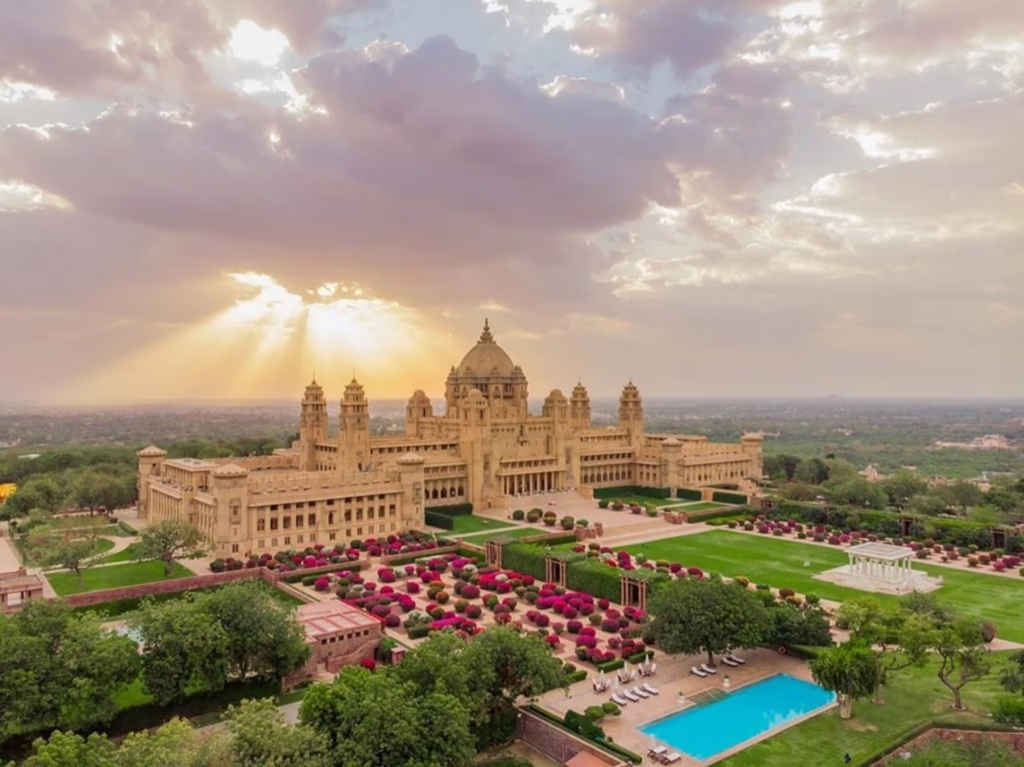
Umaid Bhawan
A heritage-style boutique hotel built in 1993 by the Rathores, a family descended from the erstwhile royals of Borunda, and the flagship that launched the Umaid hotel group. It is not an old building, but it is a convincing one: hand-carved balconies, courtyard gardens, open terraces, and a rooftop restaurant that runs a live puppet show at dinner, the kind of specific touch that tells you the place is run by people who care. You also get an outdoor pool and traditional rooms with private balconies, the facilities the simpler Bani Park guesthouses lack.
On Bank Road behind the Collectorate, it sits about a 5-minute drive from both the railway station and the Sindhi Camp bus stand, with free hotel pickup from each, and the old city is a short auto, roughly 15 minutes in traffic. You are in a calm residential quarter here, so plan on autos for sightseeing. Skip it if you want to walk to the sights, or if you specifically want a genuinely historic building rather than a well-made tribute to one.
Check prices and availability → · 8.8 on Booking + free cancellation on most rooms

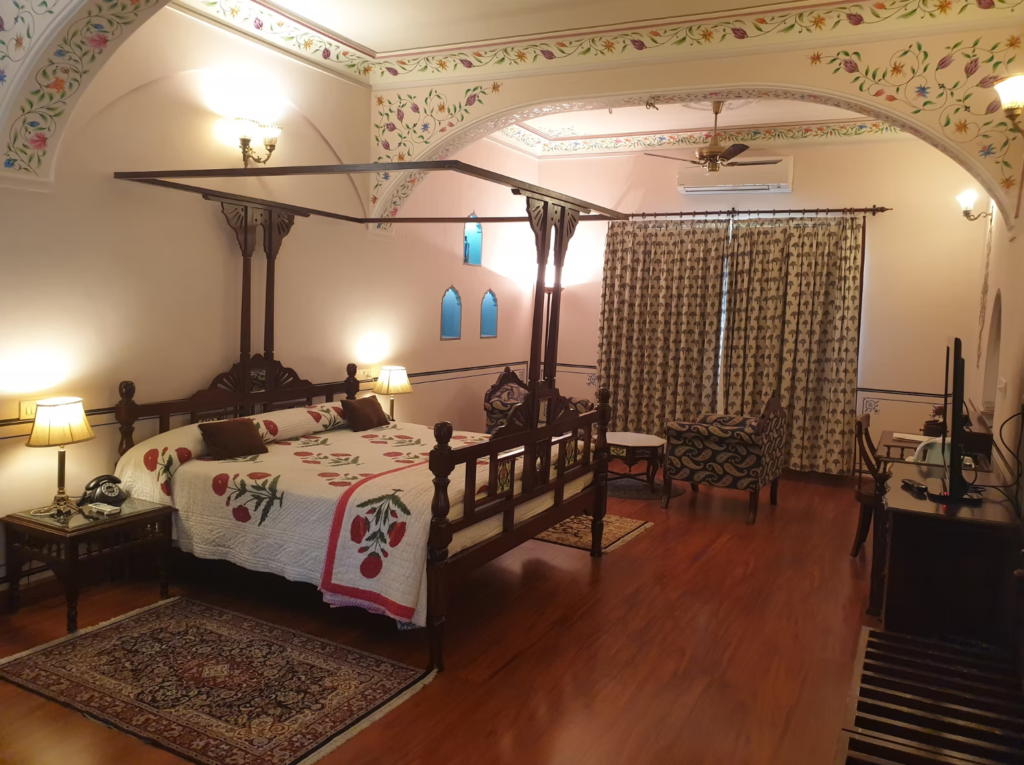
Jas Vilas
A family-run garden hotel with one of the highest guest scores in the city, the kind of personally run place where the service, not the marble, is the differentiator. A swimming pool, lawns, and air-conditioned rooms with unusually large work desks, all set in a low-rise garden compound that stays calm.
In Bani Park about a 5-minute drive from Jaipur Junction, it makes an easy base for onward trains to Agra, Jodhpur, or Udaipur, with residential, quiet immediate streets and the old-city sights a 15-minute auto away. Skip it if you want dining or nightlife at your door. This is a peaceful garden base, and that is the entire point.
Check prices and availability → · 9.6 on Booking + free cancellation on most rooms

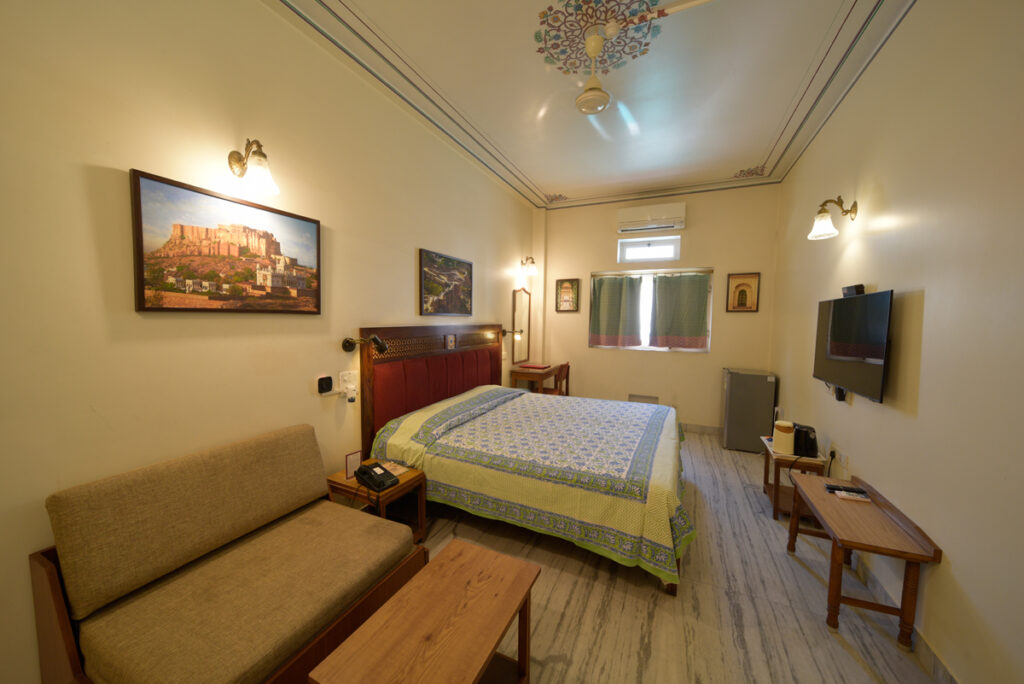
Tara Niwas
A small boutique-budget hotel engineered for a soft landing on the cheap. Air-conditioning and heating, private bathrooms with hot water, blackout curtains, and good bedding, plus a garden, a vegetarian restaurant, a library, and luggage storage. It covers the small things that actually decide whether a cheap night is restful, which most budget hotels quietly skip.
In a peaceful Bani Park setting about a 5-minute drive from both Jaipur Junction and the central bus stand, it makes early departures painless, with autos the move for the old-city sights. The on-site veg restaurant and travel desk let you land, eat, and skip the logistics on night one. Skip it if you want to step out into bazaars and bustle. Bani Park is the quiet side of Jaipur, by design.
Check prices and availability → · 9.0 on Booking + free cancellation on most rooms
MI Road and Panch Batti: best for a practical central base near transport and shopping

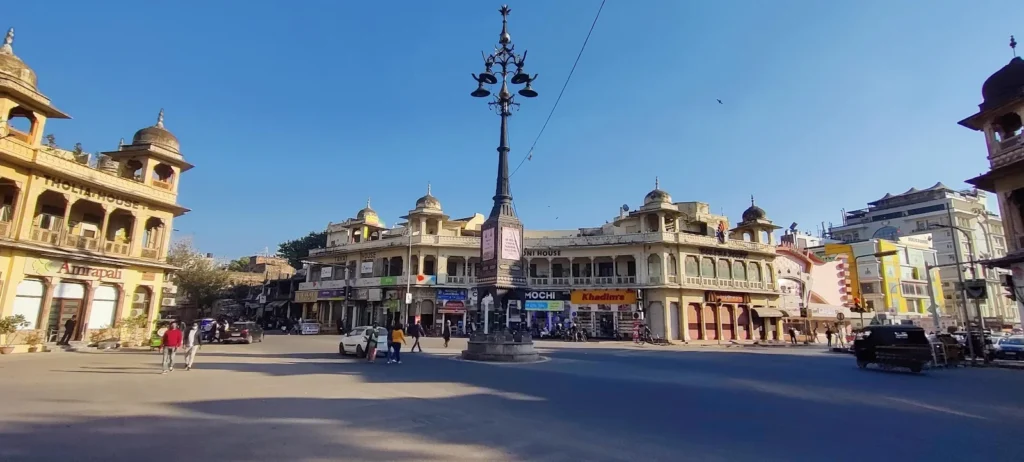
MI Road is Jaipur’s main commercial artery, running from the edge of the walled city out toward the modern districts, and it is the city’s great practical compromise. Shops, restaurants, banks, the GPO, the famous Raj Mandir Cinema, and quick autos into the Pink City all live along it. You are not sleeping inside the history here, but you are never far from it either.
The feel is busy and commercial, with the traffic and noise that implies, and a few hotels sit right on the loud main road. The payoff is that everything is close: food, shopping, the railway station, and a short hop to the old city. The Sansar Chandra Road side, which threads between MI Road and the walls, is the sweet spot, and it is no accident that a couple of the best-value central hotels are tucked there, close enough to walk into the Pink City but with a pool and a garden to come back to.
For short stays, shoppers, and anyone who wants a central base that splits the difference between old-city atmosphere and modern convenience, MI Road earns its place on this list.
Pros: central and walkable to shopping and Raj Mandir, quick autos to the old city, the station close for onward travel. Cons: traffic and commercial noise, less charm than the heritage quarters, and some hotels sit on genuinely busy roads.
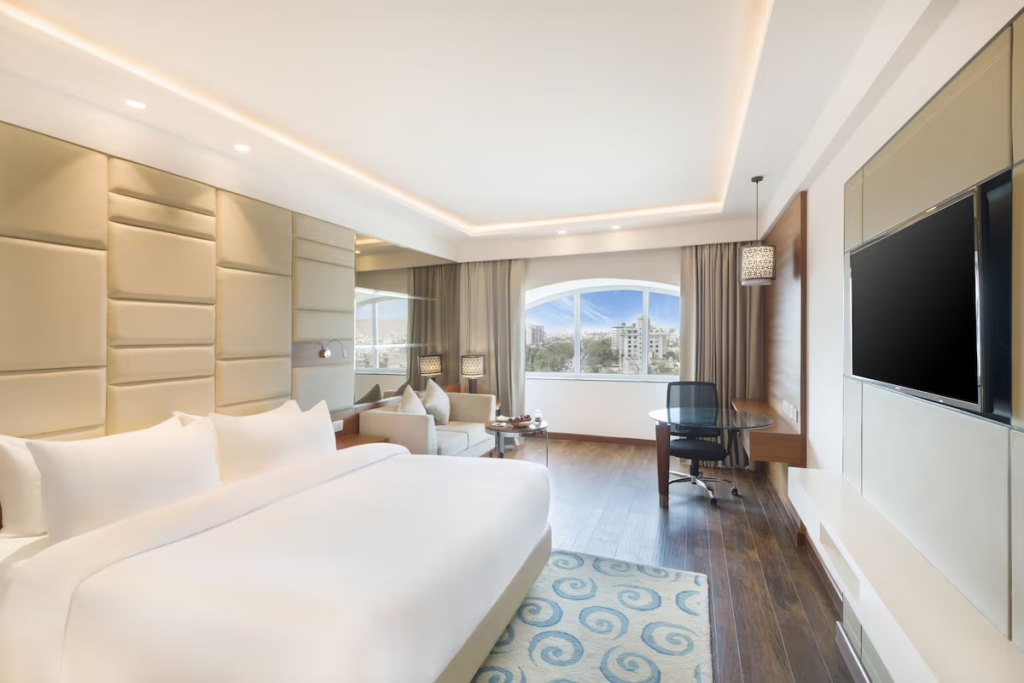
Radisson Jaipur City Center
A reliable international five-star at the modern end of MI Road, with a rooftop pool, a gym, an on-site restaurant, and standard rooms around 29 square meters, which is generous for the rate. It is the comfortable, predictable choice on this stretch, with chain-standard sleep quality on a road that never fully goes quiet.
At Khasa Kothi Circle on MI Road, near the GPO and a short ride from Jaipur Junction, it puts the old-city sights a 10-to-15-minute auto away and MI Road’s shopping and the Raj Mandir Cinema essentially at the doorstep. A strong base if you want a central location with chain reliability. Skip it if you want heritage or quiet. It is a business hotel on a main artery, and it reads that way.
Check prices and availability → · 8.3 on Booking + free cancellation on most rooms
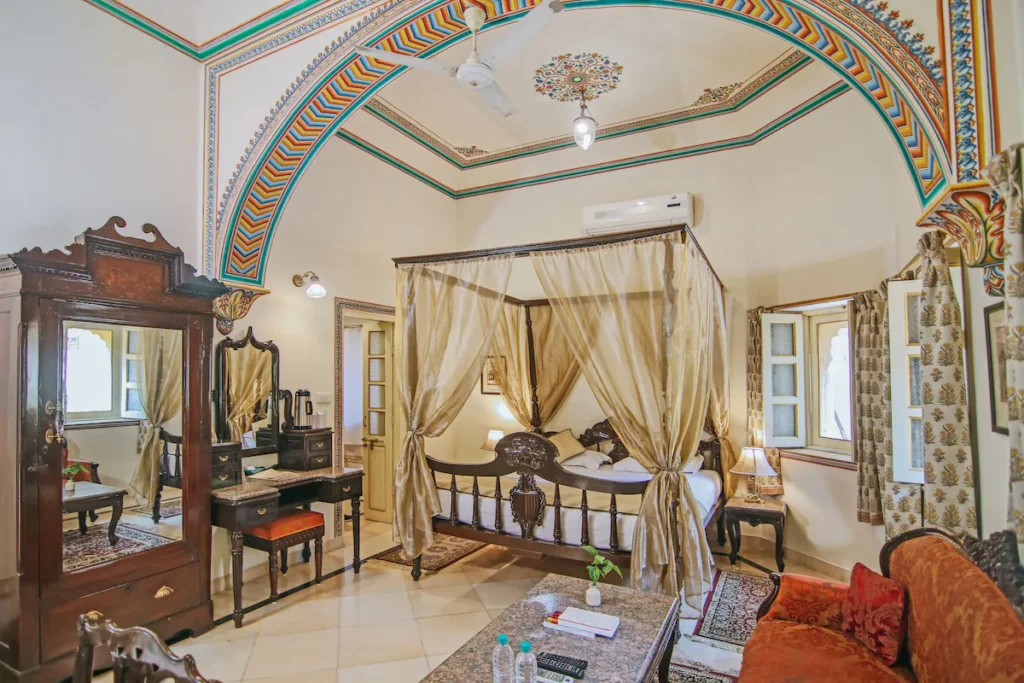
Alsisar Haveli
Built in 1892 as the Jaipur retreat of the Thakurs of Alsisar, a Shekhawat noble family whose fort out in the Shekhawati region goes back centuries, Alsisar Haveli pulls off something most properties in its class cannot. It carries genuine heritage, painted courtyards, frescoed walls, and individually styled Rajput rooms built from the bones of a real aristocratic residence rather than applied as decor, and it is still owned and run by the Alsisar family that built it. It also has an outdoor pool and a rooftop, which the havelis buried deep in the old-city lanes simply cannot offer.
On Sansar Chandra Road, it sits about a 5-minute walk from the walled Pink City and a 2-minute drive from MI Road, an unusually good combination: heritage atmosphere, a pool to cool off in, and the old city reachable on foot. The railway and bus stand are close for onward travel.
Skip it if you want a sealed, modern, ultra-quiet room. It is a 130-year-old haveli on a busy road, with the charm and the occasional creak that come with the territory.
Check prices and availability → · 8.5 on Booking + free cancellation on most rooms
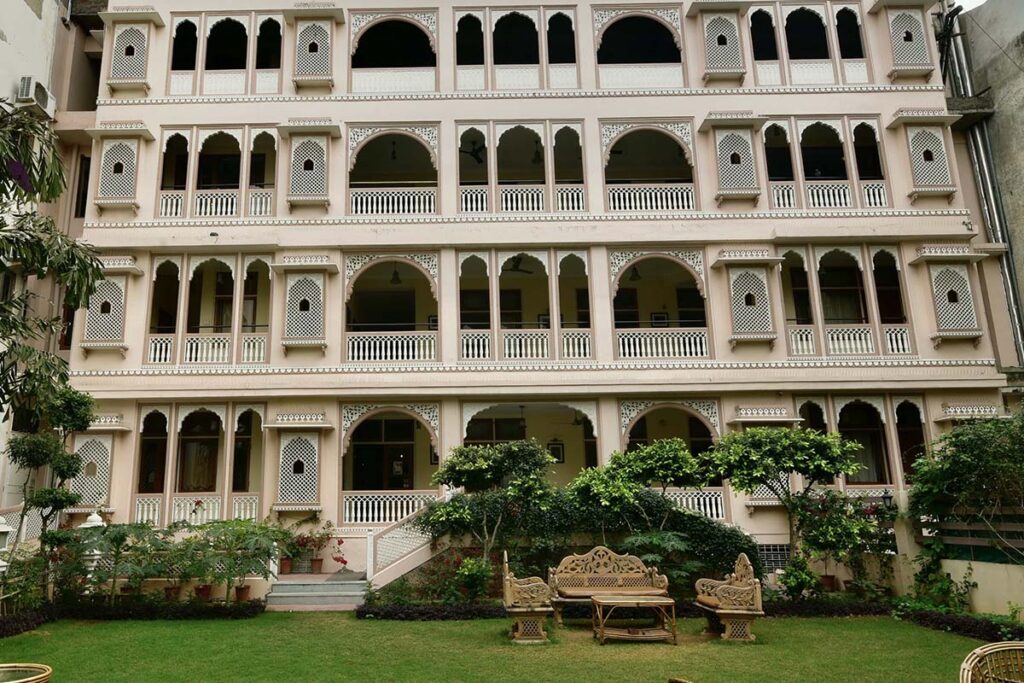
Hotel Arya Niwas
A Jaipur institution with a real origin story. In 1983 a retired engineer converted a rundown haveli that had once belonged to a feudal lord of old Jaipur State into a clean, affordable hotel, designing every part of it himself with his sons instead of hiring an architect. The main hall is around 150 years old, and the place is still family-run today.
What that family obsession buys you is a calm, well-kept budget hotel that runs better than its price suggests: air-conditioned rooms, a well-regarded vegetarian restaurant, a landscaped lawn, and ayurvedic massage, with some rooms opening onto a balcony or terrace. The garden setback keeps it quieter than the road outside.
Just off Sansar Chandra Road near the Raj Mandir Cinema, it sits about a 20-minute walk or a short auto from both the Jantar Mantar observatory and Hawa Mahal, with MI Road’s shopping in the same central radius. Skip it if you want a pool or hotel-grade frills. The value here is a calm, characterful, well-run room in a central spot.
Check prices and availability → · 8.8 on Booking + free cancellation on most rooms
Civil Lines and Rambagh: best for quiet, leafy luxury and a refined base
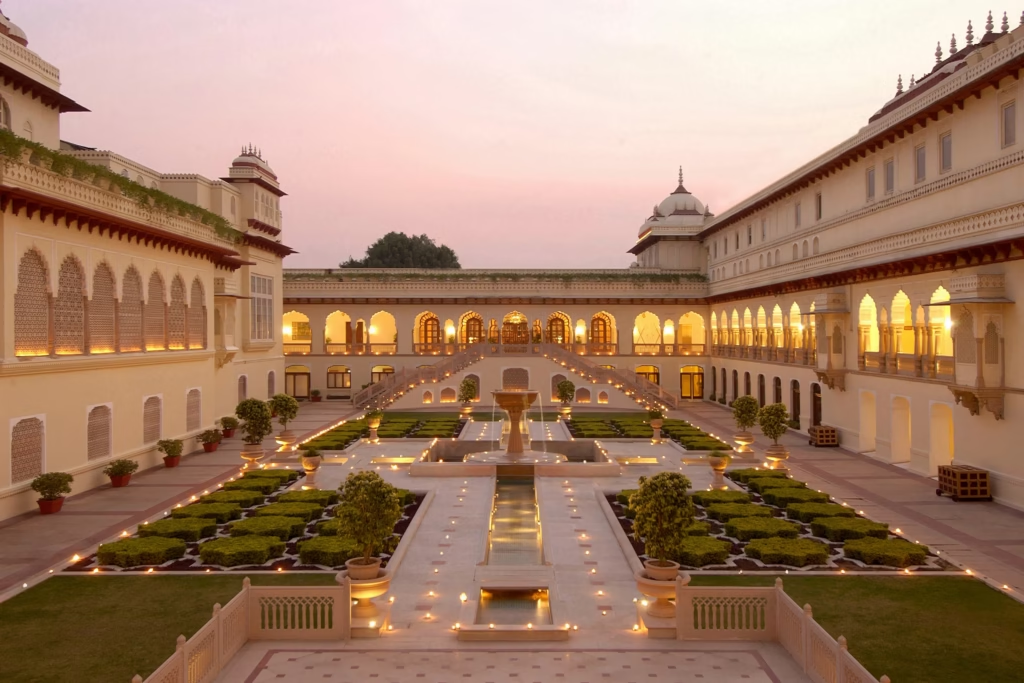
Civil Lines is Jaipur’s establishment quarter, the leafy, low-rise spread southwest of the center that grew up around the palace hotels and the wide, tree-lined avenues of the old British-era cantonment. This is the calm, green, slightly diplomatic side of the city, and it holds the single grandest address in Jaipur.
Life here runs slow and quiet, with broad roads, easy cabs, and almost nothing to see on foot, which is the deliberate trade. You ride into the action rather than stepping into it. Civil Lines has its own metro station on the Pink Line, and the whole area swaps market theater for comfort and sleep. This is where you stay when the room matters more than the view from its window, and when a peaceful night counts for more than being able to hear the city.
For luxury seekers, light sleepers, and travelers who want a refined, restful base and do not mind a short ride to the old city, Civil Lines and Rambagh are the answer, at both ends of the budget.
Pros: quiet, leafy, and genuinely upscale, with excellent sleep and the city’s best heritage luxury. Cons: very few sights on foot, cabs needed for everything, and little of the market atmosphere that draws people to Jaipur in the first place.

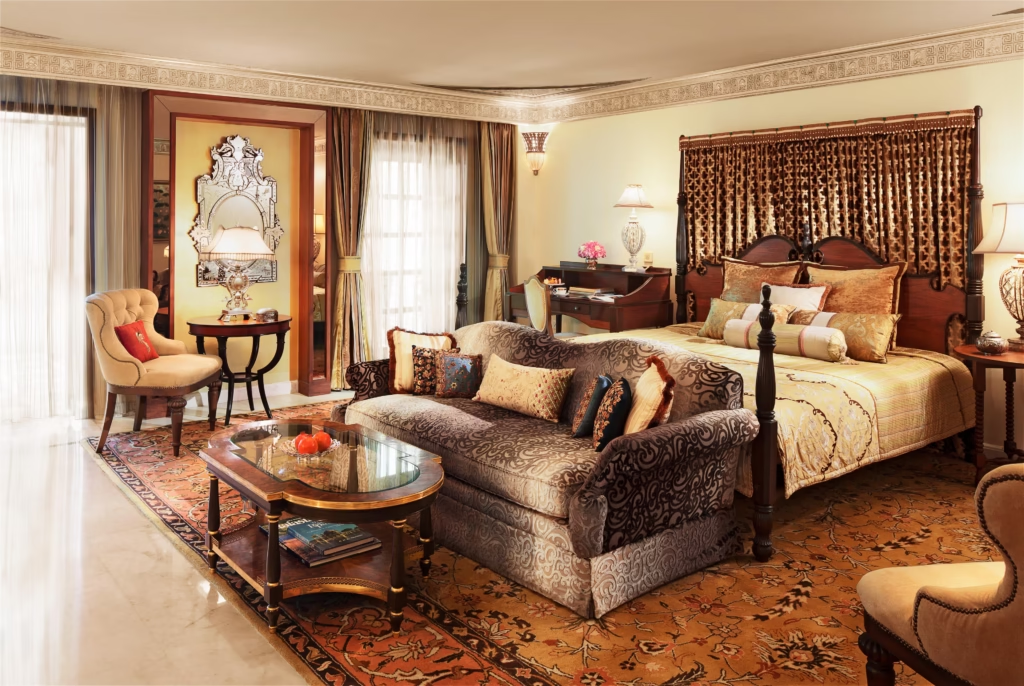
Rambagh Palace
The bucket-list address, and the rare hotel that is itself a reason to visit a city. Rambagh began in 1835 as a garden house for the wet nurse of a Jaipur prince, grew into a royal hunting lodge, and was finally enlarged, to designs by the British engineer Sir Samuel Swinton Jacob, into the principal residence of Maharaja Sawai Man Singh II. He lived here through the mid-20th century with Maharani Gayatri Devi, the famously glamorous queen, and in 1957 he did something no Indian royal had done before: he opened his palace to paying guests and created the first palace hotel in the country. Taj has run it since 1972.
The facilities match the billing: indoor and outdoor pools, a full spa, a 24-hour fitness centre, and several restaurants, including the gilded Suvarna Mahal dining room and a verandah tea service that is an event in itself. The rooms and suites are furnished in heritage style without tipping into museum stiffness, and the service is the reason people save for years to spend a single night.
On Bhawani Singh Road in the Rambagh quarter, set well inside its own walled gardens, it puts the Moti Dungri temple about a 15-minute walk away, the old city’s Ajmeri Gate a short auto, and the railway roughly a 15-minute drive. You ride to the sights, and that is entirely the point. You are paying for the lawns, the peacocks, and the sense of stepping into Gayatri Devi’s Jaipur, not for walking into a bazaar. Skip it only if the price simply is not your trip.
Check prices and availability → · 9.5 on Booking + free cancellation on most rooms
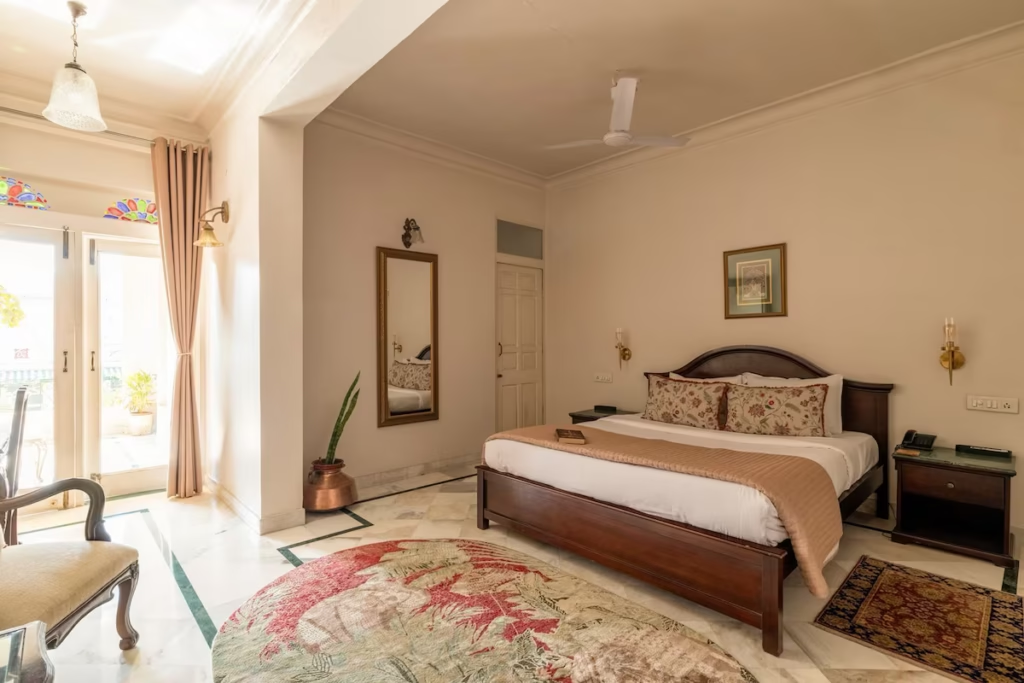
Barwara Kothi
Built in the early 20th century by Thakur Man Singh of Barwara as his family’s Jaipur residence, Barwara Kothi is a colonial-era villa in the Lutyens-Delhi spirit, with British Raj proportions, antiques, and old family photographs spread across some 2,000 square yards of Civil Lines. It is the most characterful non-palace stay in this quiet quarter, run as a heritage homestay by a mother and daughter-in-law who have kept it personal for more than fifteen years.
Garden views, a terrace, a library, and an on-site restaurant come with the intimate feel of staying in a private family home rather than a hotel. There is no pool, and the scale is small by design.
On Jacob Road in Civil Lines, it sits about a 19-minute walk from Jaipur Junction and a 14-minute walk from MI Road, so the central shopping strip is reachable on foot, which is rare for this leafy area, with the old-city sights a short auto beyond. Skip it if you want resort facilities or big-hotel buzz. The charm here is precisely that it is still someone’s home.
Check prices and availability → · 9.4 on Booking + free cancellation on most rooms

66 Residency
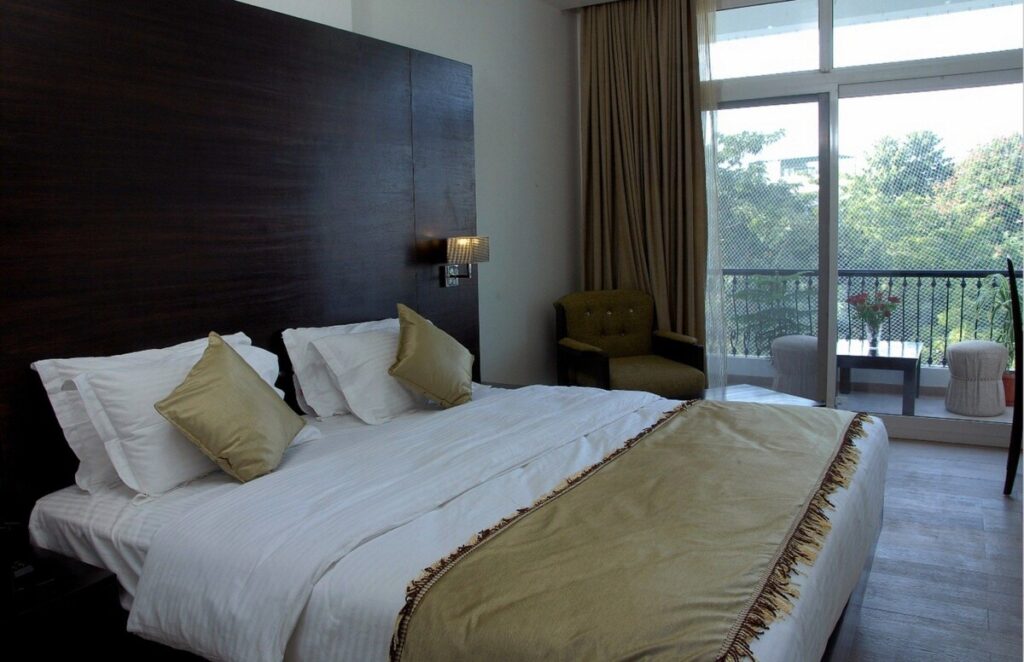
A tidy little boutique hotel that offers the best cheap proper-hotel room in this upscale quarter: 22 air-conditioned rooms, private bathrooms, and an in-house dining hall. No frills, but clean, well run, and quiet, the budget way to borrow Civil Lines’ calm.
On the Gaurav Nagar side, it is about an 11-minute walk from the Civil Lines metro station, which puts the Pink Line and easy rides across the city within reach, with Jaipur Junction a short auto away and the old-city sights a quick ride beyond. The residential setting keeps nights quiet. Skip it if you want character or facilities. This is a practical, comfortable base at a low rate, and it is honest about being nothing more.
Check prices and availability → · 9.6 on Booking + free cancellation on most rooms
Amer and the Amber Fort area: best for the fort, the hills, and a quieter second-visit base

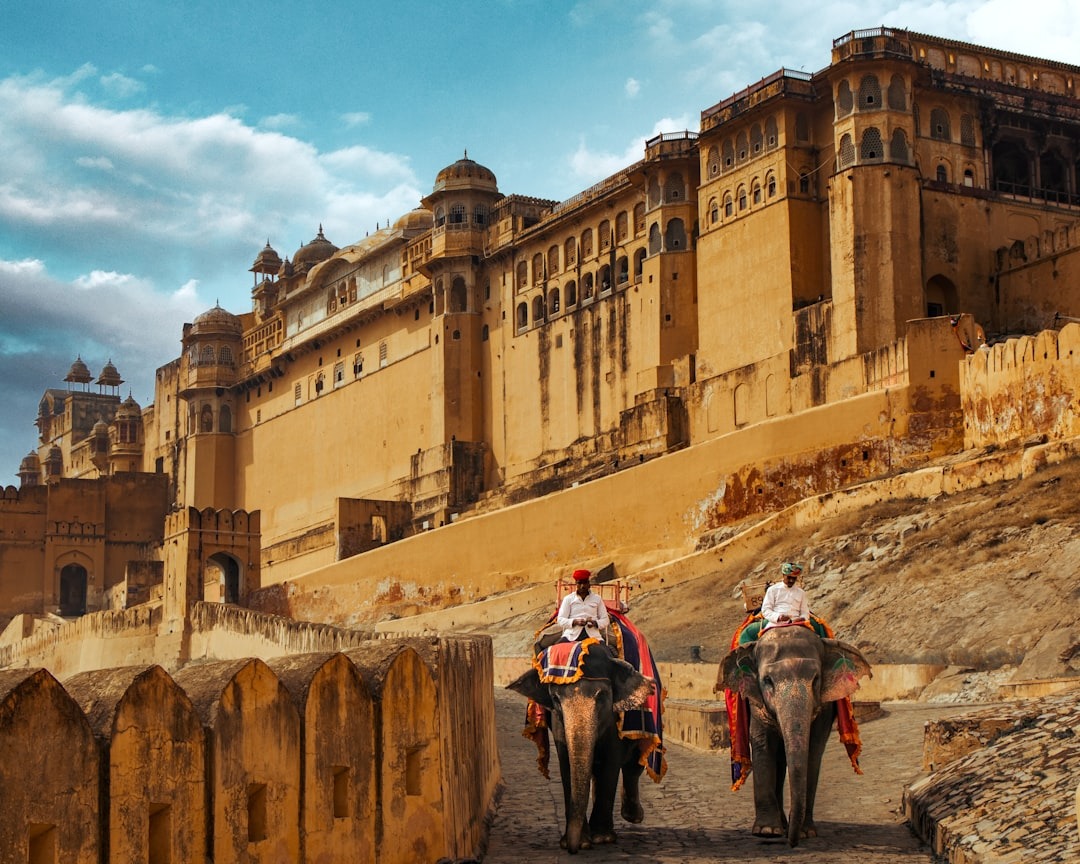
Amer is where Jaipur began, the original capital eleven kilometers north of the modern city, set against the hills where Amber Fort, Jaigarh, and Nahargarh look down over the valley. Staying up here is a deliberate choice to put the fort landscape ahead of city-center convenience, and for the right traveler it is the best decision in this whole guide.
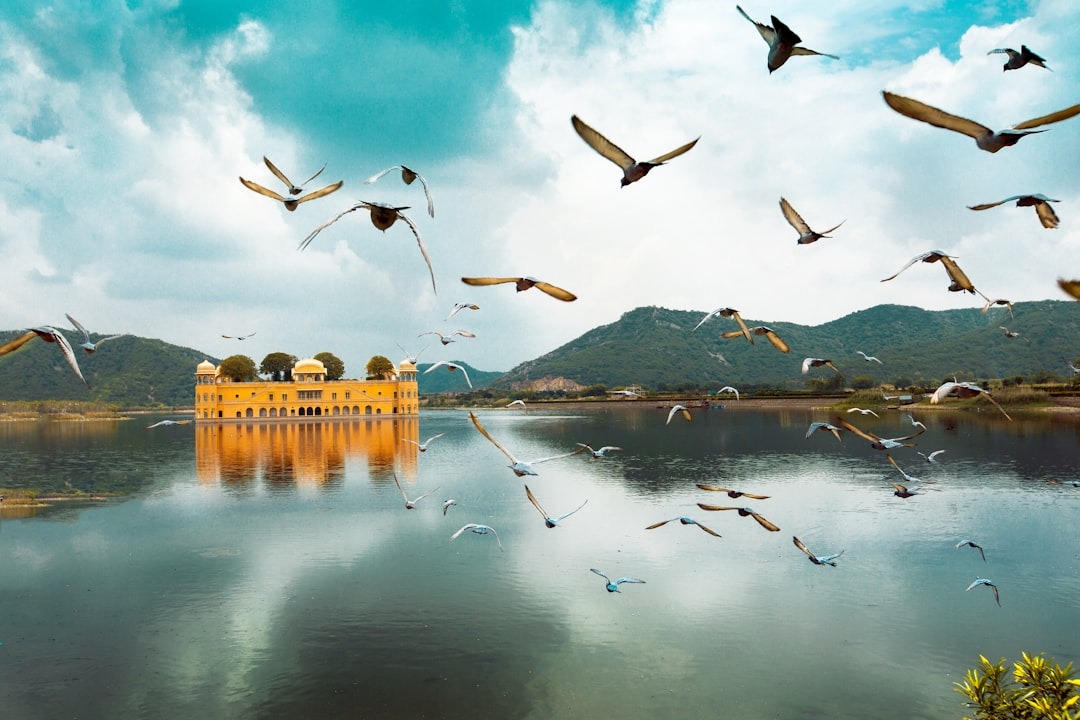
The area is quieter and more spread out than the city, with hill views, the Hathi Gaon elephant village, and the floating Jal Mahal palace on the lake you pass on the way in. Restaurant density is low and you are on cabs for any city sightseeing, so this is not a base for spontaneous dinners or quick museum runs. What it gives you instead is space, scenery, and the single best reason to stay out here: a morning at Amber Fort, walking up before the tour buses and the heat arrive, when the ramparts are nearly empty and the light is still soft.
For fort lovers, photographers, and returning visitors who have already done the city core, Amer is the calmer, more scenic edge of Jaipur, and a genuinely different experience from sleeping inside the walls.
Pros: Amber Fort close, real hill scenery, quiet nights, and resort-style options. Cons: far from the old city and its food and shopping, cabs needed for everything in town, and low restaurant density once you are off the hotel grounds.
The Leela Palace Jaipur
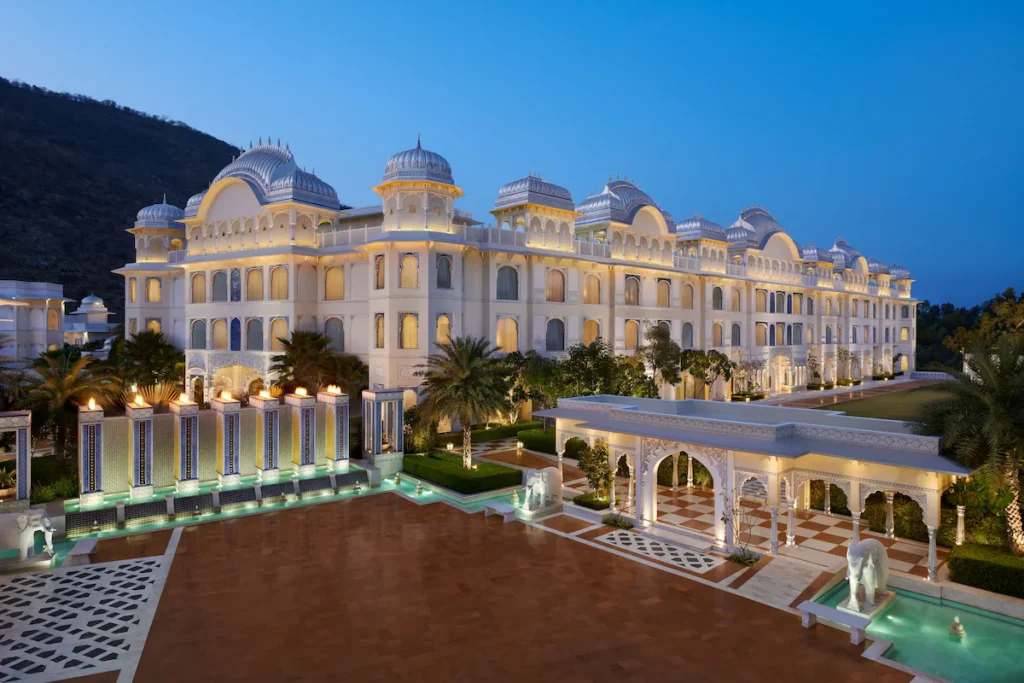
A palace-style luxury resort on the northern edge toward Kukas, built in the grand Rajput manner with a spa, a fitness center, an outdoor pool, and two restaurants, all set in a garden-and-courtyard compound that feels sealed off from the world. It is the international-luxury choice on the Amer side, the place to retreat into resort calm with the fort country at hand.
On the Jaipur-Delhi Highway at Kukas, it puts Amber Fort and Jal Mahal each about a 15-minute drive away, with the airport roughly an hour out on the far side of the city. You are committing to the quiet, scenic north here, well away from the old-city bustle, which means cabs are the default for everything. Skip it if you want to walk to sights or dip easily into city life. This is a destination resort, and it asks you to settle in and stay a while.
Check prices and availability → · 9.2 on Booking + free cancellation on most rooms

Hathi Mauja
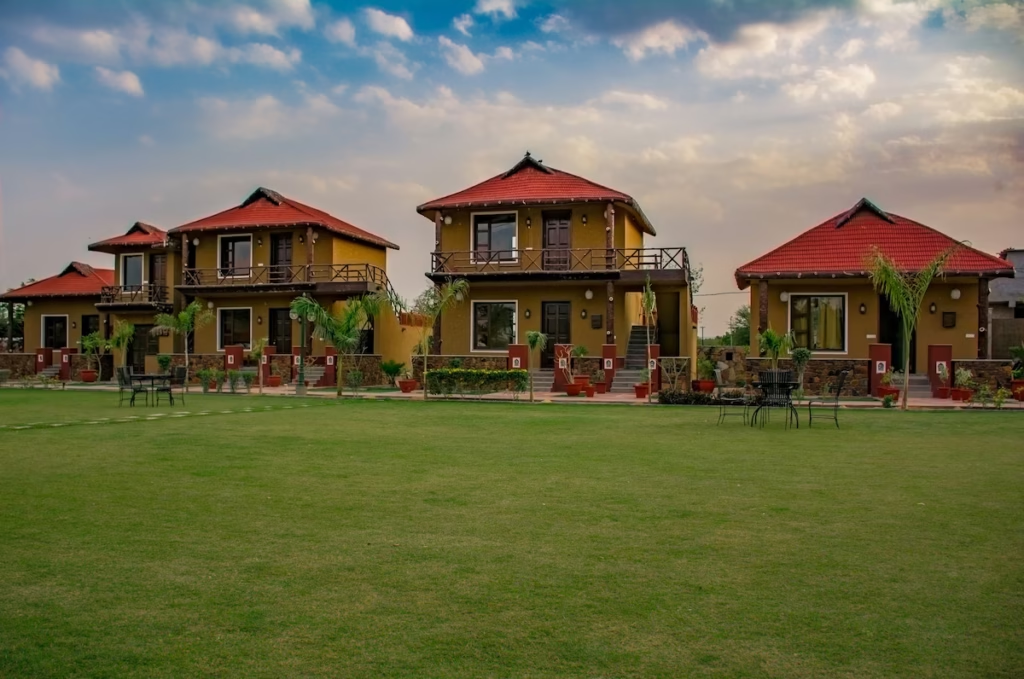
A relaxed resort-style stay near the elephant village, closer to an apart-resort than a standard hotel, with an outdoor pool, two restaurants, and spacious rooms that include kitchens and balconies. It is a comfortable, good-value base on the Amer side, built for travelers who want room to spread out near the fort.
In Amer, it sits about a 10-minute drive from Amber Fort, with the Hathi Gaon elephant village a 2-minute walk away, an unusual micro-hook if the elephants are part of the draw. The city center is a 20-to-30-minute drive, so this is firmly a fort-first base. Skip it if you want walkable dining or quick city access. Amer trades convenience for quiet and scenery, and this leans all the way into that.
Check prices and availability → · 9.6 on Booking + free cancellation on most rooms

Cocoon Auberge
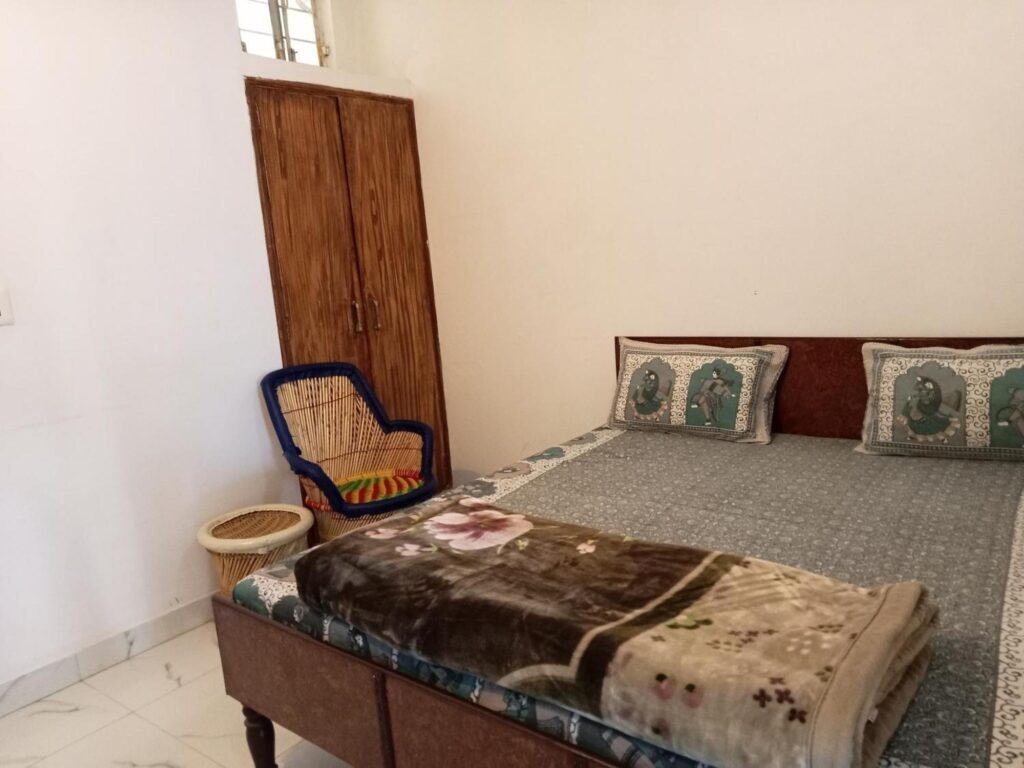
A bright little guesthouse, the cheapest high-scoring option on the Amer side, with air-conditioned rooms, private bathrooms, balconies looking out on the hills or the city, a shared kitchen, and a sun terrace. Simple and friendly, it is a soft-landing budget room with an outlook most cheap hotels cannot touch.
In Amer near the EleSafari elephant experience, a 6-minute walk away, it puts Amber Fort about a 20-minute walk or a short auto from the door, with the city’s sights and restaurants a cab ride out. Skip it if you need hotel service or want to be near the city’s food and shopping. This is a peaceful, scenic budget base built for fort-focused days.
Check prices and availability → · 9.5 on Booking + free cancellation on most rooms
Where not to stay (for a first visit): Tonk Road and the southern airport belt
The southern stretch along Tonk Road, out toward Malviya Nagar and the airport, is full of modern hotels and malls like World Trade Park, and it is genuinely convenient for a business trip or a quick airport turnaround. For a first visit built around the sights, though, it is the wrong base, and it is worth saying so plainly. You would spend a real chunk of every day in autos heading back north toward the Pink City, the City Palace, Hawa Mahal, the Jantar Mantar, Amer, and the MI Road food and shopping. The hotels themselves can be perfectly good. The geography just works against you. Unless you specifically need the airport or the malls, base yourself in one of the six areas above and keep your sightseeing time for sights.
FAQ
Where should I stay in Jaipur for the first time? The Pink City if you want the sights and bazaars on your doorstep and don’t mind the noise, or C-Scheme if you’d rather have a reliable modern hotel and easy roads with a short auto to the sights. Both are strong first-visit bases for different temperaments.
Is it better to stay inside the walled city or outside? Inside the Pink City for atmosphere and walkable landmarks, at the cost of traffic and lighter sleep. Outside, in C-Scheme, Bani Park, or Civil Lines, for quiet, comfort, and better hotels, at the cost of a short ride to the sights. It comes down to whether you optimize for atmosphere or for rest.
How many nights do you need in Jaipur? Two to three. Two covers the City Palace, Hawa Mahal, the Jantar Mantar, the bazaars, and Amber Fort at a reasonable pace. A third lets you add Nahargarh, Jaigarh, or a slower run at the markets, and is worth it if Jaipur is more than a Golden Triangle checkbox.
Is Jaipur safe for tourists? Broadly yes, with normal city caution. It is one of India’s most visited cities and well set up for travelers. Use app cabs or prepaid autos to skip fare haggling, keep an eye on your belongings in crowded bazaars, and women travelers will find it manageable with the usual awareness.
How do I get from Jaipur airport to the city? The airport is at Sanganer, about 13 kilometers south. An Ola or Uber runs roughly 250 to 400 rupees, and there’s a prepaid taxi counter if you’d rather a fixed rate. Most central areas are 20 to 40 minutes out depending on traffic.
Which area is best for Amber Fort? Stay in Amer itself if the fort and the hills are your priority, especially for a beat-the-crowds morning visit. From any central base, Amber Fort is roughly a 25-to-40-minute drive, so a half-day trip works fine too.
Final thoughts

Jaipur is the easiest door into Rajasthan, and it pays you back for matching your base to the trip you actually want rather than the trip a brochure sells you. The decision really comes down to one question: how much chaos do you want between you and your bed?
If the answer is “bring it on,” sleep inside the Pink City and accept the horns as the soundtrack to waking up a few minutes from Hawa Mahal and the jewelry markets. Samode Haveli is the splurge that makes the noise worth it, and Jaipur Haveli does the same trick for far less. If the answer is “handle it for me,” C-Scheme and Civil Lines were built for you, the one modern and convenient, the other leafy and refined, both a short cab from the sights and a long way from the racket. Bani Park is the quiet compromise by the station, ideal if Jaipur is one stop on a longer Rajasthan run and you have early trains to catch. Amer is the outlier and the connoisseur’s pick, the base for anyone who would trade restaurant choice and city access for a near-empty Amber Fort at sunrise. And MI Road is the practical middle, central and walkable to the shopping, with the old city a five-minute ride away.
The year I spent in Rajasthan taught me that you can do Jaipur badly by sleeping in the wrong place and brilliantly by sleeping in the right one, and the difference is rarely the hotel itself. It is the walk, or the drive, between your room and the thing you came to see. So pick the area that matches your tolerance for chaos first, then the room that takes sleep seriously, and let the pink walls do the rest. Then go find a plate of dal baati churma and a cold lassi, and start at the City Palace before the heat does.